
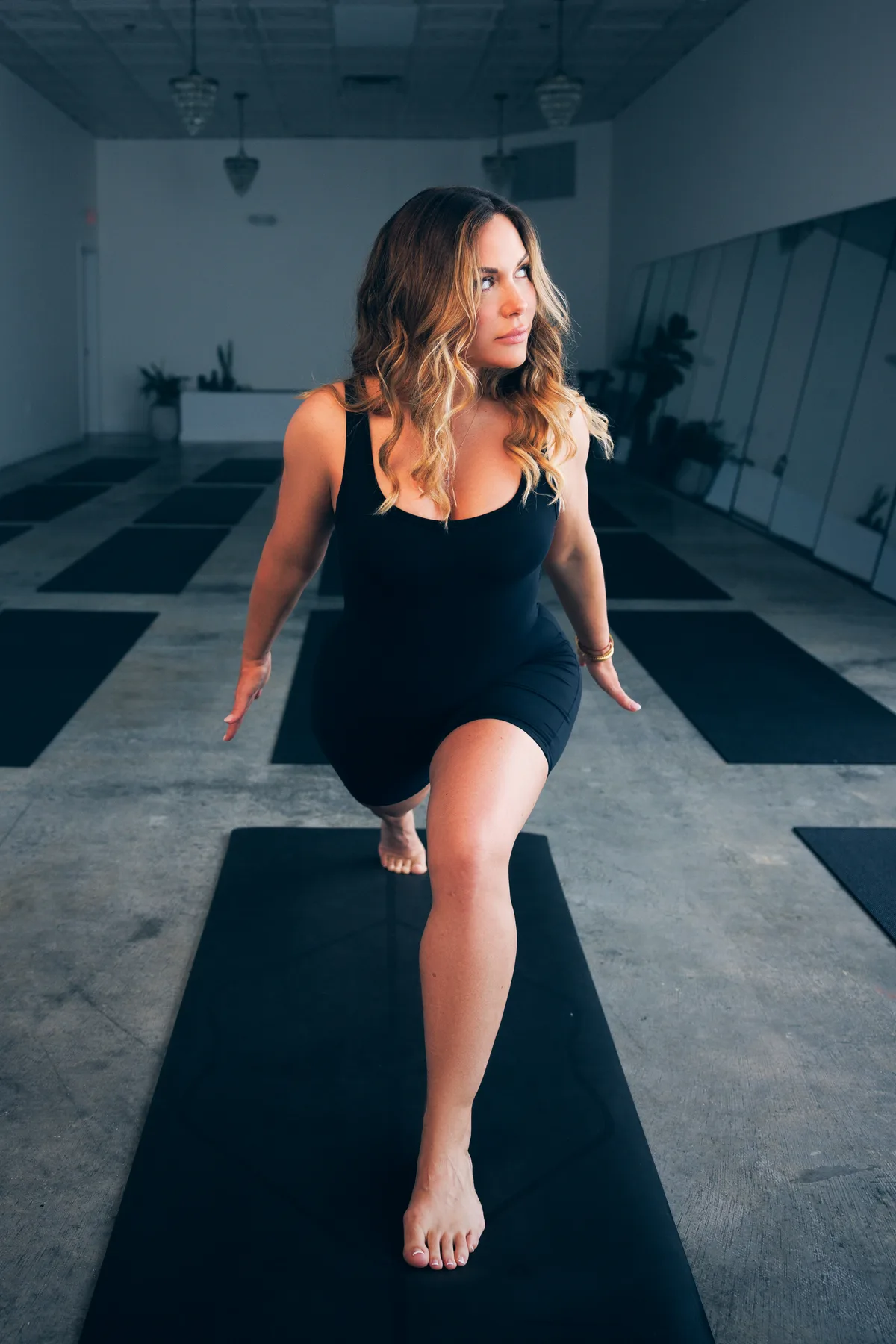
Begin with enough room for the step
Look behind you before starting. Give yourself clear floor space and move loose weights or belongings out of the stepping path. Begin from a stance that feels stable rather than placing your feet on an imaginary tightrope. A little side-to-side width can make the setup easier to organize.
Ask the instructor to demonstrate the intended step length and range. There is no universal distance that fits every person. A very short step may feel crowded, while a very long one can make returning awkward. Start without added weight so you can learn where your foot needs to land before making the exercise more demanding.
Separate stepping from dropping
Place one foot back deliberately, then bend through the split stance at a pace you can control. Avoid throwing the leg backward and immediately sinking as far as possible. The foot placement is part of the repetition, not an interruption before the important work begins.
Keep the front foot planted and let the knee track in a direction consistent with the foot rather than collapsing inward. Your torso position should follow the specific exercise being taught. Ask for feedback instead of trying to force an exaggerated upright pose or forward lean based on a remembered social-media demonstration. Use a smaller comfortable range while learning.
Make the return as controlled as the descent
Press through the front foot to return, bringing the back foot forward without a hurried hop. Find your starting stance before beginning the next repetition. If you need several extra steps to regain position each time, reduce the range or ask about a stationary split-stance version.
Do not judge the exercise only by whether you can touch the back knee to the floor. Depth, balance and load are separate variables. Stop if the movement causes pain. An easier version that preserves the intended action is more useful than repeating a dramatic step that you cannot finish smoothly.
Choose a useful variation for the class format
A stationary split squat removes the stepping transition and can help you focus on lowering and rising. Light support may also make a practice version more manageable when the instructor offers it. These are changes to the task, not a ranking of who belongs in the advanced group.
ACE's programming guidance emphasizes adapting exercises to the participant, equipment and session goal. In a timed circuit, you can perform fewer deliberate repetitions rather than rush to match someone else's count. If alternating sides makes the sequence confusing, ask whether completing a controlled set on one side before switching fits the class plan. Keep both sides in the workout.
Progress the part you actually want to improve
Choose one goal: a more consistent foot placement, smoother return or controlled range. Adding dumbbells, increasing depth and accelerating the stepping pattern all at once makes it difficult to identify what improved. Once the basic version is repeatable, ask an instructor which next change supports your training goal.
At LA Cycle + Yoga, check the strength-class information and ask about variations before the first round starts. The point is not to promise that every session contains reverse lunges. It is to arrive with a better way to learn when they appear. A clear starting stance, deliberate step and organized return can turn a rushed circuit exercise into useful strength practice that you understand well enough to repeat.
Explore your next step
Sources & further reading
Practice at a manageable effort, stop movements that cause pain and ask your instructor to clarify unfamiliar exercises. Check the current schedule for class formats and availability.